The Identity and Intellectual Trajectory of the MEPIELAN Centre
The MEPIELAN Centre, an international academic hub for research, education and training, as well as for institutional advocacy, continues, throughout all these years, to cultivate and promote forward-thinking in the fields of international environmental law and governance, policy, and international negotiation. From its establishment within Panteion University as a University Centre in 2002 to its evolving presence in important international roles and institutional settings, the Centre has, in my view, consistently pursued its mission with dedication and intellectual commitment. Today, operating as an International Non-Profit Civil Organization (INGO), it remains steadfast in advancing academic research, international training, and sustained institutional engagement.
Its academic soul has evolved continuously through its website since its establishment in 2002, while its academic “sword” has been embodied in the MEPIELAN E-Bulletin, launched in July 2010 and now marking fifteen years of circulation. Guided by an open-access philosophy and sustained entirely on a voluntary basis, the Bulletin offers authoritative insight articles, reflective opinions, selected documents and case analyses, book reviews, and news on thematic areas central to the Centre’s work. In doing so, it bridges theory and practice within international law as a system of public law, international environmental law and governance, and the international negotiating process.
At the heart of this long-standing endeavor lies a steadfast goal: to contribute to the development of an integrated, interdisciplinary, relational, context-sensitive, and sustainably effective conception of law as governance—an approach that creates, protects, and advances international common interest for present and future generations. This approach transpires that a strictly positivist or “objective” conception of international law does not merely simplify but distorts the complex and evolving realities of the international order, disorienting our understanding and judgement of its multiple functions, power dynamics, and, above all, the interpretation of its effectiveness – particularly when it is reductively measured against inappropriate analogies drawn from the private law order.
This is not a moment for celebratory rhetoric. MEPIELAN has always navigated its course through the dedication of academics, scholars, and emerging researchers bound by a shared voluntarist ethos. Over time, some have stepped aside while new intellectual forces have joined, strengthening the Centre’s academic and institutional journey. We consciously distance ourselves from superficial and performative forms of self-celebration. Instead, we remain committed to raising our voice at the highest level of scholarly engagement, particularly in an era marked by uncertainty and distortion—where international law is often undermined by reductive positivism and overshadowed by geopolitically driven narratives that dominate public discourse, frequently at the expense of rigorous knowledge and critical thinking.
Educational and Research Achievements in 2025
For 2025, the Centre’s work is marked by two achievements in which we take measured pride.
The first is the organization and successful implementation of the online UNEP/MAP–MEPIELAN Training School “Sustainable Marine Governance in the Mediterranean” (13 October – 13 November 2025). Inspired, designed, and conducted by the MEPIELAN Centre, and supported by UNEP/MAP and EPLO, this initiative constituted a significant and innovative educational event. Over five weeks, distinguished academics, international scholars, and experts from key international institutions—including the UNEP/MAP Barcelona Convention Secretariat, the UNECE Aarhus Convention Secretariat, the OSCE, and the European Environment Agency—created a vibrant and intellectually rigorous learning environment.
The 18 lectures, delivered over five weeks, offered forward-looking perspectives grounded in extensive experience and deep expertise. They created an authentic academic and expert educational space — a space characterized by high-quality learning and practical exchange of views, which was strengthened by the active engagement of participants across countries, time zones, and institutional boundaries. They explored the multifaceted challenges of marine governance in the Mediterranean and beyond, combining academic insight with practical engagement in a genuinely collaborative framework. The vision underpinning this initiative extends well beyond conventional training models; it represents an important step toward the development of a future joint international master’s programme between MEPIELAN Centre, UNEP/MAP, and EPLO.
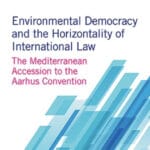
The second achievement is the publication of an authoritative scholarly work: Environmental Democracy and the Horizontality of International Law: Advancing the Mediterranean Accession Agenda to the Aarhus Convention (Edward Elgar Publishing, November 2025). Building on an earlier international project undertaken by MEPIELAN and developed into a monograph by the undersigned, the book engages an underexplored yet critically important area: the advancement of environmental democracy through broader accession to the Aarhus Convention, with particular focus on the Mediterranean region.
The work challenges overly positivistic views in the international legal literature, shedding light on fundamental methodological dimensions that are often overlooked—specifically, the horizontal dimension of international law, its “relational” conception, associated, inter alia, with the complex processes of shaping and functioning of normative interlinkage between treaty regimes. It specifically highlights the interlinkages between the Aarhus Convention and global environmental, economic, trade, technological regimes, and human rights frameworks, advancing a conception of “international law as governance” grounded in relational foundations and dynamics.
In this vein, the book provides the tools for implementing this process. A central element of the book’s contribution is the concept of “creative negotiation,” understood as a structured relational governance process that integrates negotiation into treaty-making and implementation. It proposes the development of inclusive negotiating capacities, collective diplomatic strategies, and the strategic expansion of Aarhus Centres as key instruments for effective participation in environmental decision-making at all levels, both international and domestic.
Finally, the book puts forward a concrete proposal: the process of acceding to the Aarhus Convention for the non-UNECE Mediterranean countries and beyond requires “the infusion of multilateralism” through a Pre-negotiation phase – the building of a multilateral approach to the accession procedure. This would entail structured and coordinated engagement among Mediterranean states, the Aarhus Convention Secretariat, and, potentially, the Barcelona Convention Secretariat, under the initiative of a leading actor such as the European Commission or a major state party. Organizing an ad hoc multilateral conference on Southern Mediterranean Accession to the Aarhus Convention could produce a political declaration on Southern Mediterranean Accession, establishing a shared platform for accession, facilitating coordinated policy development, minimizing political disruption, and strengthening regional cohesion in the promotion environmental democracy, while simultaneously enhancing the intercultural value of implementing participatory environmental governance based on the Aarhus Convention.
Going beyond conventional legal analysis, the book adopts an interdisciplinary perspective, integrating international law, diplomacy, environmental governance, and sustainable development. Its recent inclusion in the Aarhus Clearinghouse for Environmental Democracy—the Convention’s official knowledge-sharing platform—constitutes a meaningful form of institutional recognition.
An Institutional Hope: The MEPIELAN Aarhus Centre (MAC)
Alongside these achievements, 2025 is also marked by one enduring hope: the establishment in Athens of the MEPIELAN Aarhus Centre (MAC) the Centre’s major institutional project. Operating in accordance with the OSCE’s Aarhus Centres Guidelines, MAC is designed to operate as a national centre with regional scope (Mediterranean, Balkans) and play a pivotal role in fostering participatory democracy for environmental sustainability and energy governance.
MAC, which was established as an Aarhus Centre supported by the OSCE, operates on an NGO basis and independently of the government, and aims to serve as an institutional bridge connecting public authorities, international organizations, academia, and civil society. It is intended to collaborate closely with the UNECE Aarhus Convention Secretariat, the UNEP/MAP Barcelona Convention system, relevant Greek authorities, EPLO, and academic institutions.
Although the initiative—launched in 2023 and consistently pursued since—has received support from its key international partners at its vey inception, its final realization remains pending at the national level, despite its inclusion in the National Implementation Report of the Aarhus Convention submitted by Greece. Remaining faithful to our principles, we will continue to pursue this objective with determination and clarity. Hope, indeed, dies last.
2025: Two Achievements, One Hope — MEPIELAN in a Deconstructing International Order
All this unfolds against the backdrop of a prolonged and disorienting global crisis, characterized by confusion, fragmentation, and troubling distortions of international law and governance. Increasingly, influential voices—often amplified by media power—promote simplistic and misleading narratives of a “law of the jungle,” obscuring the fundamental truth that viable solutions lie not outside, but within, the framework of international law.
International law is not a static system of rules; it is a dynamic process—one that builds, consolidates, and advances international common interest through continuous multilateral engagement and institutionalized governance, sustained by an ongoing process of creative negotiation. Even the most powerful actors ultimately pursue their objectives within this framework, relying on and reinforcing the very structures they may rhetorically question.
Peace, conflict, and global crises are addressed through the language of international law precisely because the international sphere is not empty, but rather a field of evolving possibilities—akin to a quantum space of potentialities—realized over centuries through the development of law and governance serving common interest.
And yet, one cannot but note how frequently this reality is obscured by those in positions of influence, across different levels, whose framing of public discourse tends to rely on oversimplification and distortion. It is precisely in such times that the responsibility of academic institutions such as MEPIELAN becomes critical: to uphold intellectual integrity, to resist reductionism, and to actively contribute to the reconstruction of a genuinely multilateral international order grounded in the pluralistic development of common interest.
In this respect, the enduring insight of Philip Allott remains particularly instructive. As he argued in Eunomia (1990), international law will not be able to respond to the evolving international society, nor to create adequate legal accountability, unless it reconceives itself, in its application to state-societies, as a system of public law. The defining characteristic of an international legal order corresponding to a self-conscious international society is precisely that it imposes legal accountability on the exercise of social power.
More than three decades later, this insight retains a striking diachronic relevance, offering a compelling point of reference for those engaged in the ongoing rethinking and advancement of international law in all its dimensions.
About the author

Evangelos Raftopoulos
Professor Emeritus of International Law, Panteion University, Athens, Greece, Fellow, C-EENRG, University of Cambridge, United Kingdom
- Evangelos Raftopoulos

- Evangelos Raftopoulos
- Evangelos Raftopoulos
- Evangelos Raftopoulos

- Evangelos Raftopoulos
- Evangelos Raftopoulos
- Evangelos Raftopoulos
- Evangelos Raftopoulos
- Evangelos Raftopoulos
- Evangelos Raftopoulos
- Evangelos Raftopoulos
- Evangelos Raftopoulos
- Evangelos Raftopoulos