The Geneva Declaration on Advancing Public Rights to Tackle the Triple Planetary Crisis in the Face of Geopolitical Tensions, adopted at the Eighth Meeting of the Parties (MOP-8) to the Aarhus Convention in November 2025, constitutes a significant political and normative statement reaffirming the centrality of environmental democracy in times of global uncertainty. Adopted against the backdrop of escalating climate change impacts, biodiversity loss, pollution, and intensifying geopolitical tensions, the Declaration emphasizes that effective governance of environmental crises cannot be achieved without the full implementation of procedural environmental rights.
The Declaration explicitly reaffirms the foundational principles of the Aarhus Convention—access to environmental information, public participation in decision-making, and access to justice—as indispensable conditions for legitimate, inclusive, and effective environmental and climate action. It stresses that these rights are not optional or secondary safeguards, but core governance tools enabling societies to design, implement, and monitor environmental policies that are socially accepted, scientifically informed, and legally robust.
A key contribution of the Geneva Declaration lies in its recognition that geopolitical instability must not be used to justify the erosion of public rights. On the contrary, Parties reaffirm that transparency, participation, and accountability are essential precisely in times of crisis, when accelerated decision-making risks marginalizing affected communities and weakening public trust. The Declaration thus positions environmental democracy as a resilience-building mechanism capable of strengthening social cohesion and institutional legitimacy.
The document also situates Aarhus rights within the broader international legal landscape, linking them to the implementation of multilateral environmental agreements, climate commitments under the UNFCCC, and the achievement of the Sustainable Development Goals, particularly those related to climate action, oceans, and strong institutions. In doing so, the Geneva Declaration reinforces the understanding of the Aarhus Convention as a dynamic and evolving framework, capable of responding to contemporary global challenges.
For MEPIELAN, the Geneva Declaration represents a compelling illustration of the relational and horizontal dimensions of international environmental law, echoing the Centre’s scholarly work on participatory governance and environmental democracy. As such, it merits close attention as a guiding document for future research, policy dialogue, and legal development in the field of international environmental governance.
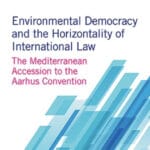
For MEPIELAN, the Geneva Declaration exemplifies the relational and horizontal dimensions of international environmental law, closely aligned with the Centre’s work on environmental democracy and participatory governance. Its relevance is underscored by the recent publication by MEPIELAN’s Director, Professor Evangelos Raftopoulos, Environmental Democracy and the Horizontality of International Law – The Mediterranean Accession to the Aarhus Convention (Edward Elgar Publishing, November 2025). This scholarly contribution is complemented by the UNEP/MAP–MEPIELAN Online Training School on Sustainable Marine Governance in the Mediterranean (October–November 2025), notably its session on public participation linking the Aarhus and Barcelona Convention systems, together demonstrating MEPIELAN’s sustained research and educational engagement in advancing participatory environmental governance in line with the Geneva Declaration.
The text of the Resolution is reproduced below
UNECE, Geneva Declaration on Advancing Public Rights to Tackle the Triple Planetary Crisis in the Face of Geopolitical Tensions, adopted at the Eighth Meeting of the Parties to the Convention on Access to Information, Public Participation in Decision-making and Access to Justice in Environmental Matters (Aarhus Convention MOP-8), Geneva, November 2025.
Electronic source:
https://unece.org/environment/documents/2026/04/reports/geneva-declaration-advancing-public-rights-tackle-triple
About the author

Evangelos Raftopoulos
Professor Emeritus of International Law, Panteion University, Athens, Greece, Fellow, C-EENRG, University of Cambridge, United Kingdom
- Evangelos Raftopoulos

- Evangelos Raftopoulos
- Evangelos Raftopoulos
- Evangelos Raftopoulos

- Evangelos Raftopoulos
- Evangelos Raftopoulos
- Evangelos Raftopoulos
- Evangelos Raftopoulos
- Evangelos Raftopoulos
- Evangelos Raftopoulos
- Evangelos Raftopoulos
- Evangelos Raftopoulos
- Evangelos Raftopoulos