Author
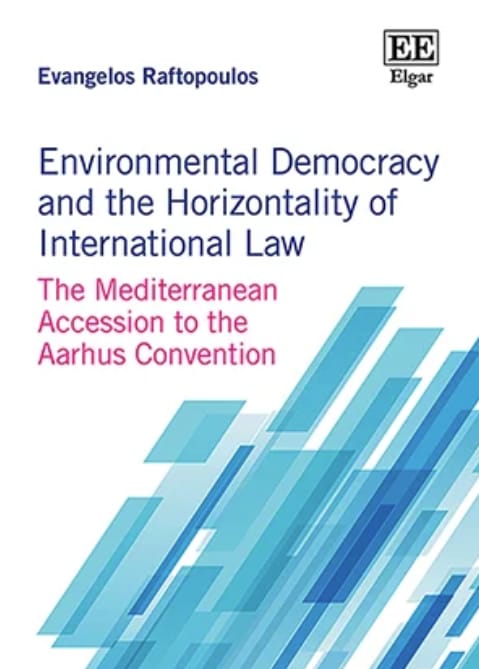
Evangelos Raftopoulos
Publication Date:
November 2025
Source
- ISBN: 978 1 03533 930 3 (case)
- ISBN: 978 1 0353 3931 0 (eBook)
- ISBN: 978 1 0353 8027 5 (Epub)
- DOI: https://doi.org/1.4337/9781035339310
- Extent: 228 pp
Keywords:
Aarhus Convention Architecture And Citizen-Centric Governance; Horizontality Of International Law; Environmental Democracy And Treaty Interlinkages; Participatory Environmental Governance Frameworks; Multilateralism In Aarhus Convention Accession Process; Prenegotiation Phase For Environmental Treaties
BOOK DESCRIPTION
This timely and forward-looking book explores how environmental democracy can be advanced globally through wider accession to the Aarhus Convention (AC), with a particular focus on the Mediterranean region. Drawing on a foundational, internationally authorized study by the author and the MEPIELAN team, Evangelos Raftopoulos presents an innovative legal and policy framework for participatory environmental governance, grounded in the horizontality of international law and the relational nature of treaties.
The book highlights the universality of the AC, examining its architecture, governance, and benefits. On the path toward a comprehensive agenda for the entry of non-UNECE Mediterranean countries into the AC, it proposes a structured and creative multilateral Pre-Accession/Preliminary Negotiation Phase to facilitate their effective integration, providing a new avenue for collaborative engagement and strategic diplomacy.
Emphasizing the transformative potential of the Aarhus Convention (AC) for acceding countries, the book explores both the theoretical and practical dimensions of treaty interlinkaging between the Convention and global environmental, trade, economic, technological, and human rights regimes. By approaching the Aarhus Convention as a catalytic instrument for building, operationalizing, and expanding environmental democracy in the Mediterranean and beyond, the analysis illuminates the creative force of the often-overlooked horizontal normative dimension of international law. It demonstrates how treaty interlinkages can foster more participatory, accountable, and forward-looking forms of environmental governance, offering a systematic and structured vision of participatory governance and international accountability.
Through its cross-cutting influence on environmental treaty regimes and on international and domestic decision-making processes, the Aarhus Convention emerges as a legally grounded and institutionally promising framework for cultivating trusteeship-oriented approaches to the promotion and implementation of environmental democracy. In this sense, it provides a pathway for advancing sustainability across the Mediterranean and beyond—an approach attuned to the governance needs and societal aspirations of Mediterranean States.
Integrating international law, diplomacy, environmental governance, and sustainable development, this book is essential reading for scholars, policymakers, legal practitioners, institutions, and civil society working across environmental law, international relations, trade policy, and global sustainability.
TABLE OF CONTENTS
Principal author, editor and contributors ix
Acknowledgements xi
List of abbreviations xiv
Introduction
Evangelos Raftopoulos
PART I: FUNCTIONAL CONTEXTUALIZATION, ARCHITECTURE AND GOVERNANCE ENGINEERING OF THE AARHUS CONVENTION REGIME
1 The emerging universality of environmental democracy
Elli Louka
1. From the Rio Declaration to the Aarhus Convention – 2. Aarhus principles in international environmental instruments – 3. Aarhus Convention and Barcelona Convention: shared
goals and values – 4. Aarhus Convention principles in the African system of
human rights – 5. Aarhus Convention principles in the Inter-American
system of human rights – 6. Green democracy in Latin America: the Escazú
Agreement – 7. Aarhus Convention principles in the European system of
human rights and EU law – 8. Aarhus Convention principles in the Constitutions of
Algeria, Egypt, Morocco and Tunisia
2 Architecture and governance of the Aarhus Convention and benefIts of accession
Elli Louka
1. Aarhus Convention and its evolution (1) First Pillar: Right to Information (2) Second Pillar: Right to Participation (3) Third Pillar: Access to Justice – 2. Governance and implementation – 3. Aarhus Convention regime process – 4. Benefts/costs of accession
PART II: INTERLINKAGES AND COMPLEMENTARITIES OF THE AARHUS CONVENTION REGIME WITH
INTERNATIONAL STUCTURES AND PROCESSES: “BIOS THEORETIKOS” (THEORETICAL LIFE)
3 The normative function of the Aarhus Convention’s interlinkages with international structures and processes: scope, operations, and perspectives (general analysis)
Evangelos Raftopoulos
1. Horizontal normativity in international order and treaty interlinkaging: the Aarhus Convention regime (1) Unveiling the Theoretical Language of the Horizontal Architecture of the International Legal
Order (2) Treaty Normative Interlinkaging – 2. Interlinkaging under Article 3(7) of the Aarhus Convention and Almaty Guidelines (1) Contextuality and Field of Application (2) Phased-process Operation (3) Participatory Application (4) Interlinkaging Directives – 3. Regime-based structural support process at work: the development of collective diplomatic strategy and the Aarhus Centres
(1) Structural Support Pattern 6 (2) Collective Diplomatic Strategy (3) Aarhus Centres
4 The normative function of the Aarhus Convention’s interlinkages with international structures and processes: specifIc applications (focused perspectives)
Evangelos Raftopoulos (1-4.1), Georgios Raftopoulos(4.2-5)
1. Interlinkaging with International Financial Institutions (IFIs) (1) Conventional and Institutional Interlinkages: An Overview (2) The World Bank (3) The European Bank for Reconstruction and
Development (4) The European Investment Bank – 2. Interlinkaging with decision-making processes of international organizations: promoting environmental transparency in the ICAO – 3. Interlinkaging with international trade negotiation process: promoting the Aarhus Convention in EU trade
agreements, WTO processes, and other developmental contexts (1) The Trade Agreements Context (2) The World Trade Organization Context (3) The Developmental Context of the Belt and Road
Initiative – 4. Interlinkaging with technological processes: implementing the Aarhus Convention in international technology governance negotiations (1) Geo-engineering (2) Genetically Modifed Organisms – 5. Interlinkaging with human rights governance: protecting
environmental defenders under Article 3(8) of the Aarhus Convention
5 Complementary interlinkages: attaining sustainable development goals through the implementation of the Aarhus Conventional regime
Evangelos Raftopoulos
1. Overview – 2. Aspects of interlinkages between SDGs and the Aarhus Convention regime – 3.Complementary interlinkages in relation to international activities
PART III PARTICIPATORY GOVERNANCE IN DECISION-MAKING AND MULTILATERALISM IN
NEGOTIATING ACCESSION TO THE AARHUS CONVENTION
6 Unlocking the Aarhus Convention decision-making and negotiating processes to advance participatory environmental governance
Evangelos Raftopoulos
1. Strengthening transboundary environmental decision-making process for inclusive governance – 2. Building capacity to negotiate environmental interlinkages in international fora – 3. Harnessing the potential of Aarhus Centres to build capacity for environmental governance-by-dialogue
7 Negotiating creatively the accession to the Aarhus Convention
Evangelos Raftopoulos
1. The architecture and management of accession for countries outside the ECE region / Morocco Ante Portas – 2. The case of Guinea-Bissau’s accession / The Accession Process – 3. Infusing multilateralism in the accession process / A Prenegotiation Phase for a Mediterranean Approach to Accession
8 Recommendations and conclusions
Evangelos Raftopoulos, Elli Louka
Annex I: Survey questionnaire 186
Annex II: Survey questionnaire respondents and results 193
Annex III: List of interviewees 206
Bibliography 207
Index 217
REVIEWS & ENDORSEMENTS
‘Accession to the Aarhus Convention by non-UNECE States is of great significance, as the Convention has from its inception provided a legal basis for such extension. Yet the issue has remained under-explored, both in its practicalities and theoretical implications. This volume, principally authored and expertly edited by Professor Raftopoulos, addresses both aspects, focusing on States of the Mediterranean region. But it also offers a much wider perspective on participatory environmental governance – introducing an original contribution to the horizontal dimension of international law and the normative interlinking of treaties – at a time when the need for it could not be more pressing.’
– Jorge E. Viñuales, University of Cambridge, UK
‘Evangelos Raftopoulos offers a compelling and authoritative legal analysis of how the UNECE Aarhus Convention can be coupled with international environmental agreements and processes – including the Mediterranean Action Plan – to promote transparency and public participation across all governance levels in the Mediterranean region, with particular significance for the acceding Mediterranean countries.’
– Peter M. Haas, University of Massachusetts, Amherst, USA
About the author

Evangelos Raftopoulos
Professor Emeritus of International Law, Panteion University, Athens, Greece, Fellow, C-EENRG, University of Cambridge, United Kingdom
- Evangelos Raftopoulos

- Evangelos Raftopoulos
- Evangelos Raftopoulos
- Evangelos Raftopoulos
- Evangelos Raftopoulos
- Evangelos Raftopoulos
- Evangelos Raftopoulos
- Evangelos Raftopoulos
- Evangelos Raftopoulos
- Evangelos Raftopoulos
- Evangelos Raftopoulos
- Evangelos Raftopoulos
- Evangelos Raftopoulos