

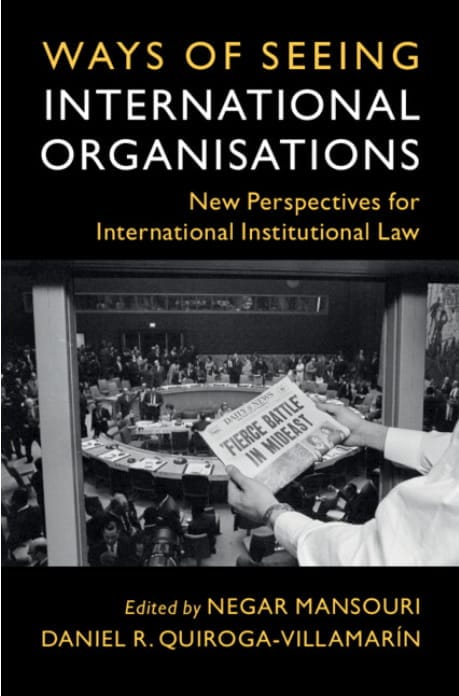
Edited by
Negar Mansouri and Daniel R. Quiroga-Villamarín
Publication Date:
17 April 2025
Source
- ISBN: 978 1 009 55262 2 (Hardback))
- ISBN: 978 1 009 55261 5 (Paperback)
- ISBN: 978 1 0353 8027 5 (Epub)
- DOI: https://doi.org/10.1017/9781009552646
- Extent: x+332 pp
BOOK DESCRIPTION
For decades, the field of scholarship that studies the law and practice of international organisations – also known as international institutional law – has been marked by an intellectual quietism. Most of the scholarship tends to focus narrowly on providing ‘legal’ answers to ‘legal’ questions. For that reason, perspectives rarely engage with the insights of critical traditions of legal thought (for instance, feminist, postcolonial, or political economy-oriented perspectives) or with interdisciplinary contributions produced outside the field. Ways of Seeing International Organisations challenges the narrow gaze of the field by bringing together authors across multiple disciplines to reflect on the need for ‘new’ perspectives in international institutional law. Highlighting the limits of mainstream approaches, the authors instead interrogate international organisations as pivots in processes of world-making. To achieve this, the volume is organised around four fundamental themes: expertise; structure; performance; and capital.
TABLE OF CONTENTS
Part I: Thinking International Organisations Differently
1. Seeing International Organizations Differently
Negar Mansouri and Daniel R. Quiroga-Villamarín
2. Critical Theory and International Organizations: The Need for an Integrated Approach
B. S. Chimni
3. Inter-disciplinarity and the Law of International Organizations
Jan Klabbers
Part II: Ways of Seeing International Institutions
Expertise, Authority, and Knowledge Production
4. Studying the Assembling of Expertise in Global Governance
Annabelle Littoz-Monnet
5. Experts, Practices, Power: The Work of International Criminal Court Reform
Richard Clements
6. Drawing the Contours of Hidden Hunger as an Object of Governance
Juanita Uribe
Structures, Spaces, and Jurisdictions
7. The Puzzle of Freedom: Structure and Agency in International Adjudication
Tommaso Soave
8. Reassembling Transnational Legal Conflicts across Global Institutions: Ethnographic Perspectives on Claims of Authority over the Mediterranean Sea
Kiri Olivia Santer
9. Placeholders: An Archival Journey into the Interim Histories of International Organizations
Daniel R. Quiroga-Villamarín
People, Practices, and Performance
10. The Micro-politics of International Commissions: The Case of Telegraphic Standards
Jan Eijking
11. Keeping Up Standards for a Better World: Anthropological Alternatives to the Study of International Organisations
Miia Halme-Tuomisaari
12. The Critic Is Not the One Who Debunks, but the One Who Assembles’: On Professional Performances and Material Practices
Dimitri Van Den Meerssche
Capital, Class, and Political Economy
13. Laissez-Faire, State Capitalism, and the Making of International Organizations: The Dynamics of a Struggle
Negar Mansouri
14. Deconstructing ‘Resilience Talk’ in Global Governance: Toward a Critical Political Economy Approach
Claire Cutler
15. A White Knight in Shining Armour? Ethiopia, International Organisations, and the Global Colour Line
Daniel R. Quiroga-Villamarín
Part III: Conclusion
16. Examining Elephants in the Dark
Guy Fiti Sinclair
REVIEWS
‘In drawing together diverse disciplinary perspectives and traditions of thought to pluralize and complicate ‘ways of seeing’ international organizations, this wonderfully rich volume advances both scholarship on international organizations themselves, and more wide-ranging inquiries about the connections between legal forms, institutional arrangements and epistemology in international law.’
Megan Donaldson – Associate Professor of Public International Law, University College London
‘Challenging the traditional lens of international institutional law, Ways of Seeing International Organisations brings fresh perspectives to the field. By interrogating expertise, structures, performance, and capital, this work transcends conventional boundaries, inspiring a critical, multidisciplinary understanding of international organisations’ socio-technical roles and world-ordering visions.’
Sundhya Pahuja – Melbourne Laureate Professor, University of Melbourne
About the author

Negar Mansouri (ed.)
Negar Mansouri is a researcher at Copenhagen Business School and holds a PhD in International Law from the Geneva Graduate Institute.

Daniel R. Quiroga-Villamarín (ed.)
Daniel R. Quiroga-Villamarin is an Ernst Mach Fellow at the University of Vienna and holds a PhD in International Law from the Geneva Graduate Institute.